
Willamette, Revisited

There’s this river near my house called the Willamette. In high school, this was my “third location”. I had my house. I had my school. And everything that didn’t happen at either of those, happened at the Willamette.
I rowed on this river every day, twice a day, for 7 years. Outside of practice, I walked on its beaches. I ran its paths. I swam across. In middle school, I did a study about the insects on its shores. In high school, it hosted bonfires. First as a COVID necessity (with 3 masked friends sitting around a fire in the middle of April), but then, as a traditional gathering place, where I’d throw crazy bonfires with upwards of 20 people. This was my social life.
I only went home for a few short weeks this summer, so, in order to reconnect, I invited everyone I could think of to a bonfire. A “one year reunion”, as sad and washed up as that sounds.
Things went fine at first. We’d all just gotten back from a ridiculous attempt to place a person onto a buoy in the middle of the river, and were enjoying a roaring fire with our toes in the sand.
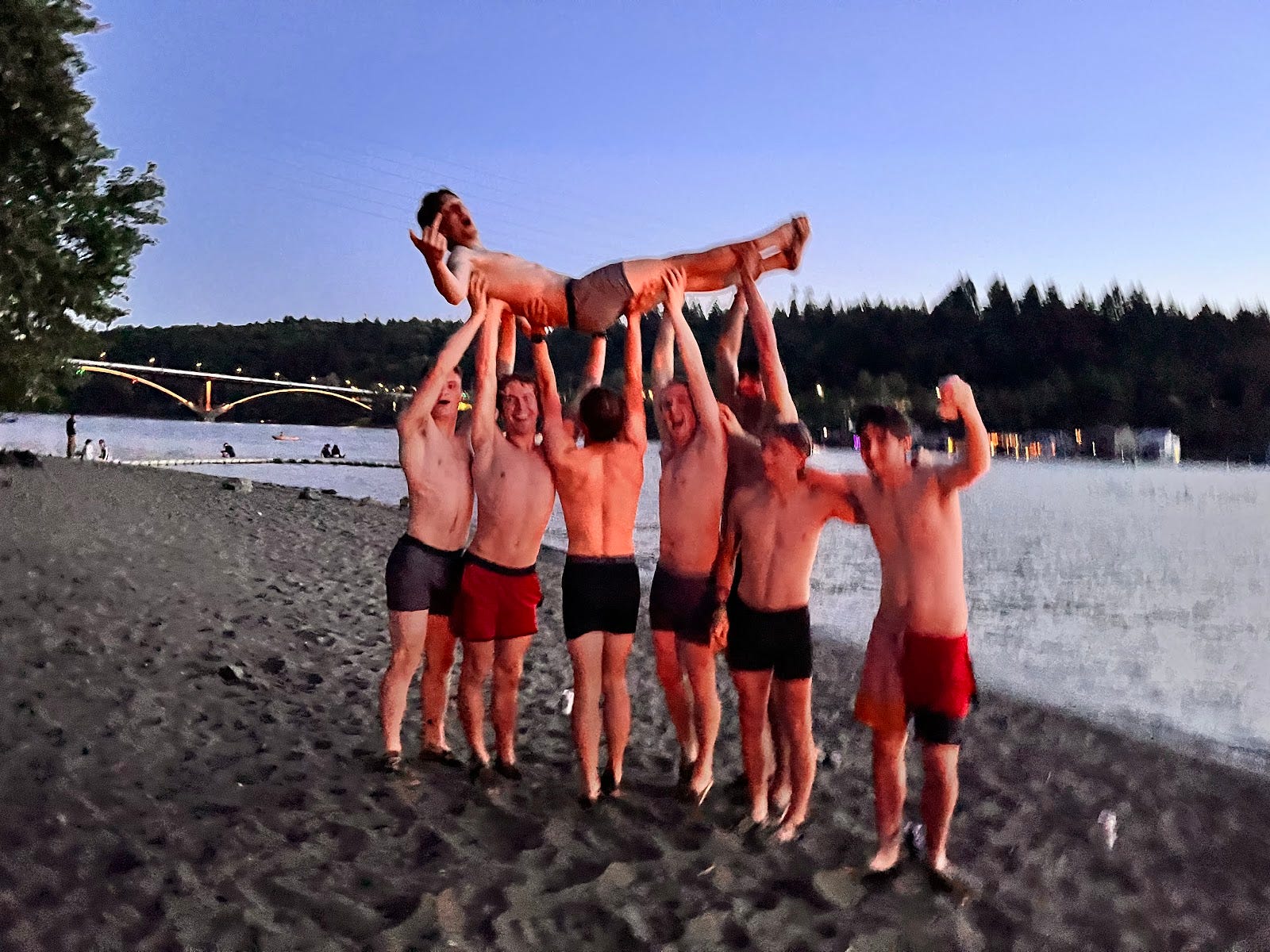
But then, groups of high schoolers started to wander into our territory.
I knew what this meant. One of the infamous “dock parties” was happening tonight. These decentralized parties involved hundreds of high schoolers, loud speakers, and enough weed and alcohol to get them all wasted. Feeling the tides shift under me, I decided to stand my ground. I’ve been here long before any of them, after all.
I began introducing myself to everyone who walked by, and hyped up my friends in front of the youth. As more and more arrived, and my little Wunderboom 2 portable speaker began to be dominated by huge boomboxes, we became a tiny island of light surrounded by a sea of people.
This period of time is a blur in my memory. Repetitive conversations, hands dapped up, old faces remembered.
Then, somewhere in the commotion, a fight erupts. Two kids, barely out of middle school, wrestling on the ground. One is short and chubby, the other tall and skinny. He has braces. A croud forms around them, cheering them on. Me and my friend Oscar watch from the side. Phones record, people yell, and finally it disperses. I walk closer to the teenagers on the ground, curious how the fight ended.
They stood up and to my surprise, the look on the fighters faces wasn’t one of anger, or sadness, or victory. They both showed kinda sheepish smiles, as though they knew each other and were both on an inside joke. Then, they blended back into the crowd and another duo took it’s turn.
Maybe it was this revelation about the nature of fighting, maybe it was the testosterone in the air, or maybe just some part of me wanting to prove I was still young. Whatever it was, before I know it, I’d grabbed Oscar from behind, and dragged him to the ground.
A crowd reforms. Coated in dust and sand, I strain to get my arm around his neck from behind, trying to force a chokehold. He fights back, and twists hard to the side. Now I’m in front of him, trying to turn him back around. He raises an arm against me, and we lock into position. We heave in exhaustion, staring open eyed, unable to move, and after ten, frozen, seconds I relax my grip, and the yells of the crowd fade away.
We fall back, arms stil intertwined, stare at the sky, and quietly laugh.
Maybe Fight Club had something figured out.
The mood changes
We stand up, and his smile goes away. He can’t find his phone–it must have fallen out during our wrestling match.
We search, and as we scan the sand, the world shifts from boyish exuberance to teenage degeneracy.
I watch fifteen year old girls walk up to random boys, desperate for someone to make out with them. I stumble past a kid lying on a bush at the edges of the party, staring into nothing, unresponsive to his surroundings. Overwhelming waves of weed smoke make it hard to even breathe, much less look for a phone. There are now multiple fights at once, and what once sounded like yells of excitement now sound like jeers and whistles.
Off to my right, there’s a disturbance in the crowd as people’s bodies move away from a patch of sand. I walk over, hoping it’s my friend’s phone. But it isn’t. Instead, there’s a kid who looks around 16, waving something around. He points it at me, and asks if I’ve seen a holster. I shake my head, confused. And then finally I realize what he’s holding.
a black pistol.
damn.
Reflections
I turned away, Oscar found his phone, and our group left pretty soon after. Everyone was fine, but I still have a sour taste in my mouth.
I keep thinking about what could have possibly led that guy to bring a gun to the river. The petty politics of high school life, excessive substance use, scared kids, people in way over their heads. It all feels so distant to me. I wondered how these people will look at these times five years from now. Will they look at themselves the same way I look at them now, as scared, scary, messed up kids?
Or, will they look at themselves the way I look at that version of myself. Burgeoning, meeting new people and being exposed to new ideas. Do the smoky crowds, random fights, and pointed guns fade with time?
The river, and the bonfires that came with it, were a formative time for me. I went from being someone who never really got invited to parties to being the guy who throws the parties. They’re when I discovered the power of organizing things, and the freedom that provides. A huge amount of who I am today came from events surrounding that river. I’ve decided to leave the Willamette to the high schoolers from now on. That’s their battlefield to fight on.